Disclosure: I am not employed by Photofeeler and I do not receive referral fees or commissions from them.
The short version
You upload one or more photos. In dating mode, voters from your selected audience rate each photo on three traits: Smart, Trustworthy and Attractive. The final scores run from 1 to 10, standardized against other photos from people your age and gender. A 5 is average. The results page also shows the vote breakdown and any notes voters left.
Every vote comes from a real person. You pick the voter gender, age range and number of votes. For dating photos, you might ask for women 25-34. The final results do not break down who cast each vote, so you cannot see the exact age behind a specific rating, but the pool is filtered before anyone sees your photo.
That makes it good for screening photos and comparing first impressions. It does not replace app results. Once you have two or three finalists, put them back on Tinder or Hinge and see what happens when your prompts, photo order and the rest of the profile enter the picture.
Photofeeler also has Business and Social categories for LinkedIn headshots and general social media.
Same face, different scores
This is the part people miss. The same guy can score 3.7 in one photo and 9.0 in another. A different smile, pose or background can move the result a lot.
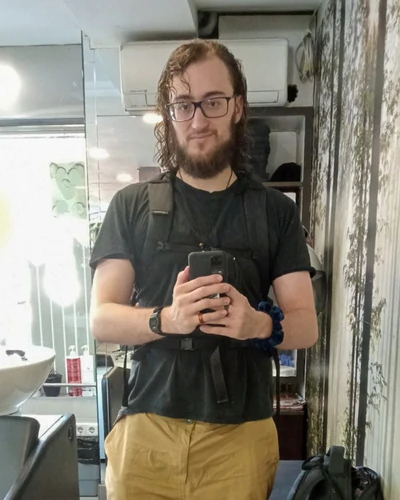
Mirror selfie at a barber shop. Backpack still on.

Suit on a rooftop at sunset. This became his main.
These photos were tested on Photofeeler during the same week. The "Before" shot is the one he had picked as his primary before I worked with him. This is where the tool helps, even if you never hire a photographer.
His face did not change. The lighting, expression, outfit, pose and background did. Those are the levers, and you control them.
So if you have ever told yourself, "I'm just not photogenic," that is usually the wrong takeaway. Most of the time the issue is the photo itself. You do not have a fixed Photofeeler ceiling.
A common Reddit version of this is "photo quality only helps if you're already good-looking." I do not think that is true. I've hit 9.0+ with guys who are below the 50th percentile in facial attractiveness, which is why I can offer the 9.0 guarantee in my dating photos service.
If you do one thing after reading this, test your current photos. Most men are worse at choosing their own primary than they think.
How voting works
Voters see one photo at a time. The traits depend on the category: in Dating they are Smart, Trustworthy and Attractive; in Social they are Confident, Authentic and Fun. Each trait is rated on a 0-to-3 scale (No, Somewhat, Yes, Very) and voters are told to judge each one separately. Someone can read attractive and untrustworthy at the same time.
Below the buttons sit a free-text field and a panel of Quick Notes. The notes are split into Feeling and Suggestion. Feeling is how you come across: "great smile," "fake," "intense." Suggestion is what to change: "blurry," "too close-up," "smile more." The score tells you where the photo landed. The notes and free-text comments sometimes tell you why.
Most voters just pick a few Quick Notes and move on, but the free-text field does get used. In my experience, women will sometimes write a specific reaction you would not get from Quick Notes alone. Your photo is only visible while the test is live, then private again.
The one-photo-at-a-time setup makes sense. Dating apps work like that. Nobody sees your top two candidates side by side and compares them calmly. They see one photo, form a quick impression and move on. A/B testing answers a different question. It also misses the very common case where both photos are weak.
How the scoring is adjusted
Most people assume Photofeeler just averages the votes. It doesn't.
Some people hand out 3s to everybody. Some barely ever go above 1. If every vote counted the same, a soft voter pool would inflate your score and a harsh one would drag it down.
Photofeeler says it adjusts for that. A 3 from someone who almost never gives 3s is worth more than a 3 from someone who gives them out freely. People who mash the same button over and over get their votes thrown out. The site also runs fraud filters, spaces out tests from the same account and blocks voting twice on the same test.
Photofeeler's CTO Ben Peterson and computer vision advisor Agastya Kalra described this normalization in a 2019 paper. By their numbers, one normalized vote carries about as much information as 2.4 raw votes. So 20 adjusted votes tell you more than 20 raw votes would on a site that just averages everything.
I fitted an approximation of the adjustment formula to 760 Photofeeler tests (12,569 votes, each rating all three traits). The fitted weights, accuracy checks and an interactive calculator are on the Photofeeler score calculator page.
Smart and Trustworthy count too
Attractiveness gets you through the first gate. Without it, the rest barely matters.
Smartness and Trustworthiness still shape who responds. Photofeeler's dating-photo guide says people drawn to those two traits are more likely to be looking for a relationship than a hookup. If that's what you want, those scores matter more than a lot of guys think.

Sitting at the barber in a gym tee. Good smile but it reads like a Yelp review photo.

Parka and Christmas lights. Scored highest in his set despite being the most casual.
This is why I do not chase one trait in isolation. A photo can get hotter and less trustworthy at the same time.
The shirtless gym selfie often disappoints for this reason. It might bump Attractiveness while crushing Trustworthiness. On Hinge, a woman is asking two questions at once: "Is he hot?" and "Would I actually want to meet this guy?"
The same logic applies to the rest of your profile. Some photos are there to prove you look good. Others make you look like an actual person. A hobby shot, travel moment, dog photo or slightly goofy image can be worth keeping even if its raw Attractiveness score is lower, because it gives someone something human to react to.
The Photofeeler voting pool
The voter pool matters, but probably less than you think. These are random internet strangers, and most of them are not the people you want to date. Still, Photofeeler has published data showing that voters at different attractiveness levels rated photos about the same. A separate study found no statistically significant difference between how managers and everyone else rated LinkedIn photos. You can pick at the methodology, but in my experience the signal is useful.
AI can't do this yet
Photofeeler is still 100% human-rated. The authors of the same 2019 paper trained a neural network on 1.2 million dating photos. Its predictions were worth about 10 raw human votes, which is statistically shaky. The model was never released, so sadly you cannot try it yourself.
It also did worse on men than on women, mostly on the Attractive score. Women disagreed with each other more, which made male attractiveness harder to predict. Photofeeler's voter data puts a number on it: voters agreed at a correlation of 0.28 when women rated men and 0.45 when men rated women. That tracks with what most guys learn the hard way. It is also why a single friend's opinion of your photo tells you so little.
How many votes you need
Every score comes with a confidence interval, a range where the "true" score probably lands if you kept collecting votes. Photofeeler shows that range with your results.
Personally, I find it easier to skip the interval math and follow a simple rule of thumb:
- 10 votes is enough for a quick yes/no when you are running through a batch and just need to cut the obvious losers.
- 20 votes is the sweet spot for every photo except your primary. Spending more would just burn credits needlessly.
- 40 votes is reserved for primary pic candidates, where a small score gap can matter.
What the critics get right
Most criticism of Photofeeler is fair enough. The question is when it should change your decision.
"Photofeeler is not Tinder."
True. Tinder and Hinge judge the whole profile: photos, prompt order, app culture and whether the profile hangs together. Photofeeler isolates one variable, so the score can disagree with your match rate. A high score tells you the photo landed well on a first pass. It does not tell you whether the whole profile closes the deal.
"A niche photo can score lower and still pull better matches."
Also true. A goofy costume shot, a rave photo or something that signals your subculture can look mediocre to a generic crowd and still outperform with the people you actually want. The generic signal helps, but it is not the same as appeal to your exact type.
"People just click fast to earn karma."
The credit system does create pressure for junk votes. Photofeeler says it filters or downweights bad raters and I assume some of that works, but I still would not treat a thin sample like gospel. More votes help drown out the drive-by clicks.
"The same photo got different scores when I reran it."
Reruns drift, especially when the sample is small or the photo is polarizing. That is annoying but it is not mysterious. Check the score range and do not make big decisions off 10 shaky votes.
"The voter pool has gotten worse. I don't trust it anymore."
I have seen this complaint on Reddit: the same photo supposedly scores 2-3 points lower now than it did in previous years. I recently retested a batch of 2023 photos with 20 votes each and saw less than half a point of variation. My guess: most of the scary examples are 5-10 vote tests, which is too thin to trust.
"Photofeeler is biased against non-white men."
I've heard this complaint most often from East Asian men. It has not matched my experience. The second case study on this page is a Chinese American client who scored 9.2 in Attractive. I cannot rule out bias in a crowd of internet strangers, but I have not seen it show up in my results.
"Optimizing photos for Photofeeler is basically catfishing because you're not showing the real you."
Apparently the only "real self" that would satisfy the critics is an exhausted selfie at 1AM after a night out. If the photos are actually you, just well lit and well composed, that is presenting yourself well. Same logic as wearing a good outfit on a first date instead of sweatpants.
"Voters are just ranking random photos on the internet, not actually swiping."
Yes, someone clicking through photos for credits is not in the same headspace as someone deciding whether to swipe right. Still, the usual alternative is asking female friends and they already know you. Photofeeler at least gives you reactions from people who have no context beyond the photo, which is close to what happens on Hinge.
How to use Photofeeler without fooling yourself
Most people waste time the same way: they upload random leftovers, overread tiny score gaps and blindly pick the top number. I use a simpler approach:
Start with technically solid photos
Do not expect useful feedback from dark, blurry, low-effort shots. If the photo looks sloppy, the result mostly tells you it looks sloppy. Start with images that are at least decent.
Show your eyes and test solo first
For primaries, visible eyes usually beat sunglasses and solo shots remove the "which guy is he?" problem. Get the clean read first. Save group shots and weirder photos for later.
Don't build a leaderboard
A dating profile needs range. Three strong anchor photos plus a couple that show humor or warmth usually beat six polished photos that all say the same thing.
If you are brand new to online dating and your current camera roll is weak, do not spend a week trying to squeeze certainty out of bad inputs. Get better candidate photos first. Then use Photofeeler to compare the finalists. It is a sorting tool. Do not treat it like an all-knowing oracle.
How I use it at GetDatingPhotos
My guarantee is a 9.0+ Attractive scoring pic or a full refund. That means every shoot gets tested before I deliver.
During photoshoots I capture a batch, then periodically test the top candidates with 20-40 Photofeeler votes. I see what does and does not score well, then adjust. That is the core of the 3-day process. Instead of me saying "I like this one" or your friends saying whatever feels supportive, I get 20-40 women's first impressions.
I also keep backup photos with strong Photofeeler scores, because dating apps and Photofeeler do not always agree. Close, yes. Identical, no.